You spent hours carefully choosing the perfect matting and molding to complement your latest acquisition. However, have you thought about what is actually protecting the art? Here at The Picture Framing Group, also known locally as The Frame Shop, our team understands that our job as professional custom framers goes far beyond simply making a piece look visually stunning. Operating under the high standards established by owners Cole and Don Glassner, our true responsibility is making sure your artwork lasts for generations. When our designers discuss preservation framing, we are talking about the exact science of keeping a piece in its current, safe state for decades to come.
Whether you are framing a priceless original watercolor, a limited edition print, or a cherished family photograph, the materials hidden behind the frame are what truly matter. In the dynamic climate of Chicagoland, where we experience highly humid summers and intensely dry winters, taking a scientific approach to art conservation is absolutely essential for long-term protection. The wrong materials can cause irreversible damage in just a few short years, while the right materials will preserve your legacy indefinitely.
The Lexicon of Conservation (Acid-Free versus Archival)
The terminology surrounding custom framing can sometimes be confusing to collectors and hobbyists alike. Words like archival and acid-free get thrown around frequently in the industry, but they are absolutely not interchangeable terms. Understanding the fundamental difference is your very first step in proper art preservation.
- Acid-Free: This classification simply means the material starts with a neutral pH level at the time of manufacture. While it is not acidic out of the box, it is only a basic safety measure. Over time, materials that are merely acid-free can still absorb damaging acids from the environment or even from the aging artwork itself. Many standard paper products contain lignin, a natural component of wood pulp that eventually breaks down and releases destructive acids.
- Archival and Museum Quality: This is the ultimate upgrade for your precious pieces. These premium materials are not only acid-free from the start, but they also contain added buffering agents. Substances like calcium carbonate are integrated into the material to actively neutralize future acid damage from the surrounding environment. If the piece is valuable, historic, or deeply sentimental, we always recommend utilizing genuine museum quality materials to guarantee total peace of mind.
The Golden Rule of Separation (Nothing Touches the Art)
The biggest threats to paper art are moisture, pests, and pressure. We fight these environmental fluctuations with deliberate physical separation. Our master framers operate by a strict set of protocols to ensure your original pieces remain entirely uncompromised.
- The Crucial Air Gap: We utilize an elevated mat or specialized acrylic spacers to create a visible, breathable air gap between the art and the glass glazing. This separation is vital. If the art touches the glass directly, condensation can easily build up as room temperatures shift. This trapped moisture often leads to rapid mold growth and can cause the piece to literally adhere to the glass forever.
- Reversible Mounting Techniques: A professional framer dedicated to conservation will never use pressure-sensitive tape or permanent glue. Every mounting technique we use must be completely reversible and chemically safe. For securing your art, our team relies on delicate methods like Japanese hinging paper combined with a purified wheat starch paste. We also use specialized corner mounts that act like tiny photo album corners for photographs and rigid prints. For highly fragile or historically significant items, we use full Mylar encapsulation to hold the art firmly in place without ever adhering to its delicate surface. Gravity is not your friend in framing; you can never rely on a piece to simply sit flat on its own without proper, safe anchoring.
Shielding from Light (The Glazing Factor)
Preservation framing is incomplete without addressing the damaging effects of ultraviolet light. Invisible UV rays will quickly fade vibrant pigments, turn crisp white paper into a dull yellow, and cause delicate materials to become brittle over time. Selecting the right glazing is a non-negotiable aspect of professional conservation.
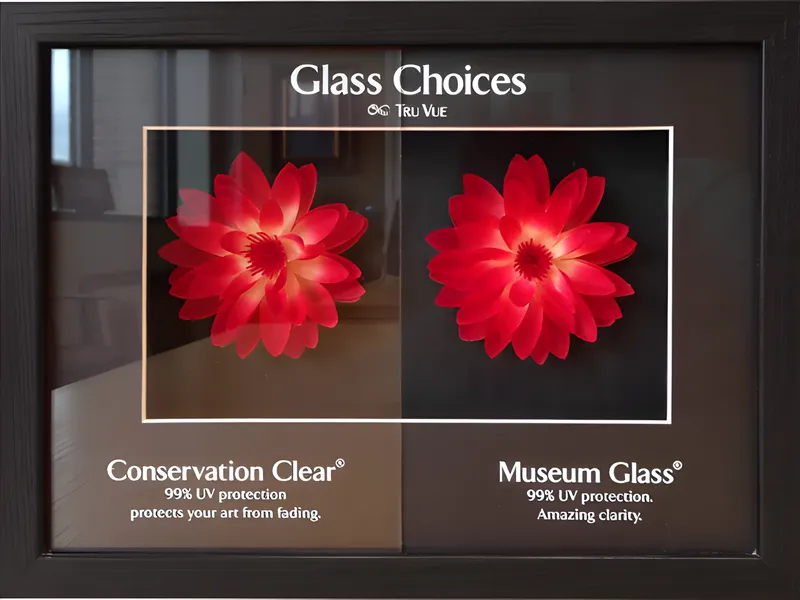
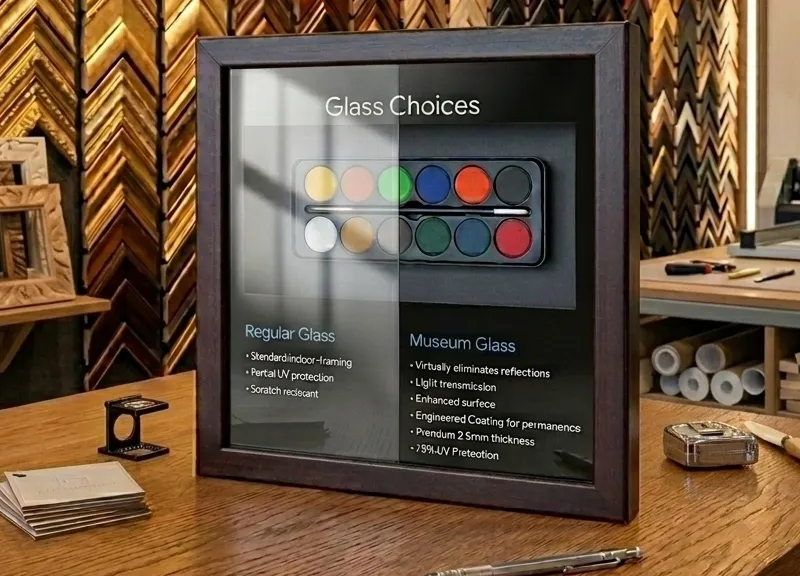
- Conservation Clear Glass: This specialized glazing blocks up to ninety-nine percent of harmful UV rays. It acts as a clear shield that prevents the invisible spectrum of light from degrading your artwork over the years. This is the baseline standard for any piece of art that holds personal or financial value.
- Museum Glass: For the absolute best viewing experience combined with top-tier protection, museum glass is the industry gold standard. It offers the same maximum UV protection as conservation glass, but it features an advanced optical coating that makes the glass nearly invisible to the naked eye. By removing distracting glare from your living space, museum glass allows you to appreciate the subtle textures and true colors of your artwork exactly as the artist intended.
Building the Conservation Sandwich
Every piece of art we frame requires a protective stack of specialized materials. We often refer to this internally as the conservation sandwich. Each distinct layer plays a specific, vital role in defending your piece from external elements and ensuring its structural integrity.
- The Primary Mount: The safest material to rest directly against your art is a premium, four-ply museum quality matboard. Crafted from pure cotton rag rather than standard wood pulp, this board serves as the primary buffer against environmental contaminants. Cotton is naturally free of lignin, meaning it will never deteriorate and burn your artwork with acid.
- The Inert Backing: Placed immediately behind the mount should be an inert barrier that will never leach chemicals over time. We frequently use fluted polypropylene boards like Coroplast to achieve this. This robust layer serves as a critical shield, protecting your art against any moisture or temperature fluctuations creeping through the exterior walls of your Chicagoland home.
- The Final Seal: The concluding step in the framing process is securing the back of the frame with a professional dust cover. Instead of basic brown kraft paper which can degrade quickly, advanced preservation framing relies on resilient materials like Tyvek or spunbonded cambric fabric. These advanced materials create a highly effective, breathable barrier that seals out dust, tiny insects, and atmospheric moisture while still allowing the framed package to acclimate safely to your home environment.
A Legacy of Protection
Preservation framing is comparable to giving your artwork the ultimate, tailored suit of armor. It requires a deep understanding of material science, environmental factors, and archival handling procedures. It is this depth of knowledge and rigorous attention to chemical stability that truly elevates custom framing from a basic craft to the creation of a lasting legacy. At The Picture Framing Group, our entire team is dedicated to employing these stringent conservation techniques. We believe your cherished memories, rare collectibles, and valuable investments deserve nothing less than exceptional care so they remain vibrant and secure for a lifetime.