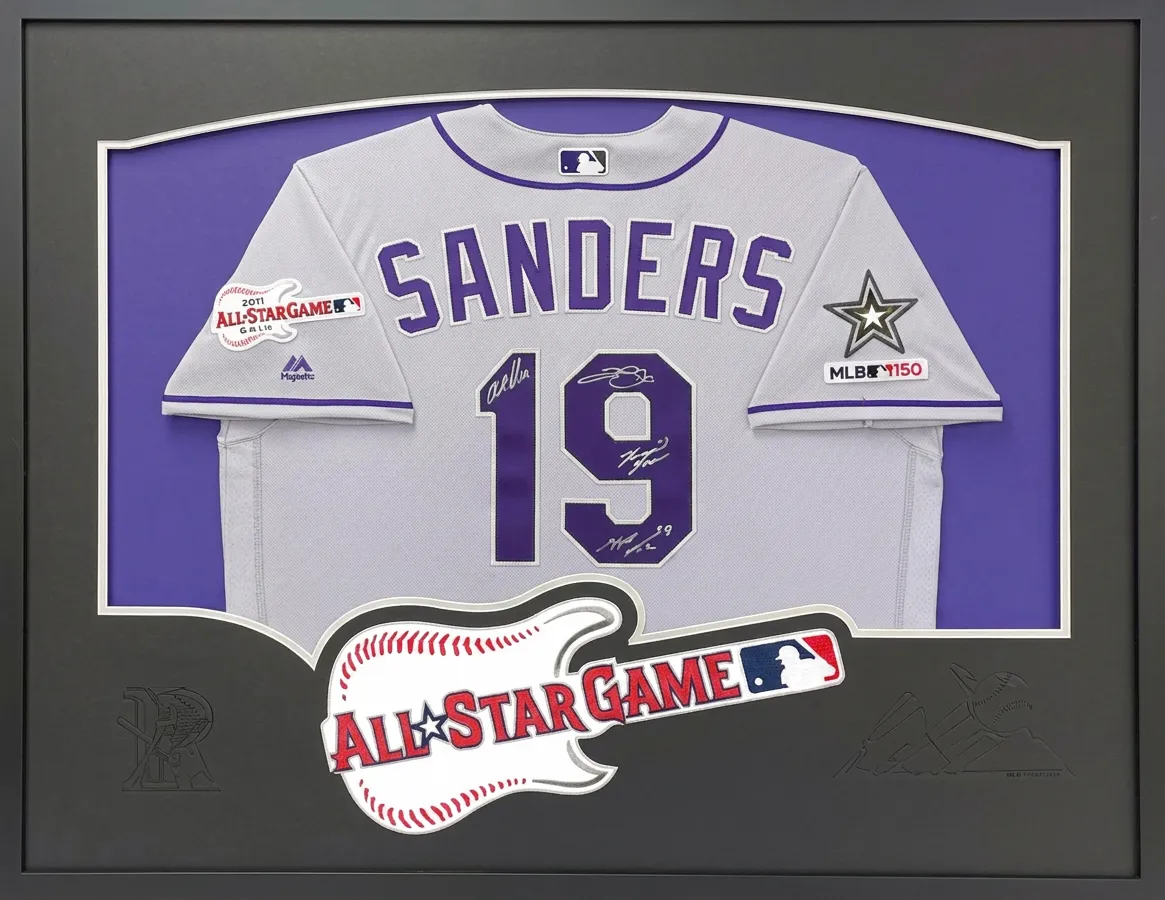
Whether you own an autographed Walter Payton or Caleb Williams Chicago Bears jersey, a signed Ryne Sandberg or Kris Bryant Cubs pinstripe jersey, a Michael Jordan or Derrick Rose Bulls jersey, or a Connor Bedard or Patrick Kane Blackhawks sweater, an authentic signed jersey is both a centerpiece of Chicago sports history and a valuable financial asset.
Unfortunately, our master framers at The Picture Framing Group (known locally as The Frame Shop) are asked every single month to “rescue” treasured jerseys that were framed two or three years earlier using DIY Amazon shadowboxes or rushed big-box retail shortcuts.
Before you let anyone put your jersey inside a frame, here are the 5 most destructive jersey framing mistakes—and how museum-grade custom jersey framing protects both the fabric and the signature for decades.
Mistake #1: Using Steel Straight Pins, Staples, or Tagging Guns
The fastest way a budget framer or DIY kit mounts a jersey is by pushing dozens of metal straight pins, staples, or plastic retail price-tag barbs straight through the jersey fabric into a foam backing board.
Why it ruins your jersey:
- Rust Stains: Even inside an air-conditioned home, ambient humidity causes steel pins to oxidize over 3 to 5 years, leaving permanent orange rust rings around the pinholes in white or light-colored jerseys.
- Gravity Tear-Outs: Heavy tackle-twill numbers and NHL hockey sweaters weigh several pounds. When all that weight hangs from tiny metal pin points, gravity pulls downward until the fabric threads stretch and rip.
The Master Framer Solution: We never use pins or staples. We cut a custom-contoured, acid-free internal torso form that supports the weight of the jersey across the entire shoulder line, and we hand-sew the jersey down using invisible archival cotton/polyester thread passing between the existing knit weave of the fabric. If you ever remove the jersey from the frame, you snip the thread on the back and the jersey is 100% untouched.
Mistake #2: Iron-On Adhesives, Double-Sided Tape, or Hot Glue
Even worse than pins is adhesive mounting. Some assembly-line operations use heat-activated fusion tape, spray adhesive, or double-sided sticky boards to flatten jersey sleeves and keep numbers from wrinkling.
Why it ruins your jersey:
- Chemical adhesives permanently bond to polyester mesh and wool fibers, immediately voiding 80% to 90% of the jersey’s collector value with authenticators and auction houses.
- Over time, adhesive solvents yellow and bleed right through the front of the fabric or peel the painted/stitched numbers off the backing.
The Master Framer Solution: 100% mechanical, zero-chemical tensioning. By inserting custom acid-free sleeve and body forms inside the jersey and hand-stitching at hidden structural points, the jersey stays crisp and wrinkle-free with zero glue ever touching the textile.
Mistake #3: Pressing the Signed Number Directly Against the Glass
Cheap “hinged-door” jersey display cases sold online are usually only 1 inch deep. When you close the door on a jersey, the stitched number (where the athlete signed in black or silver Sharpie) is pressed flat against the inside of the glass or acrylic.
Why it ruins your jersey:
- Glass conducts temperature changes rapidly. Microscopic condensation forms on the inside of glass when room temperatures fluctuate, causing the Sharpie ink or tackle-twill number to permanently stick and transfer onto the glass.
The Master Framer Solution: True deep-rabbet shadowbox engineering. We build deep hardwood shadowbox walls (lined in matching team-color mat board) so there is a dedicated air cushion between your signed numbers and the glazing.
Mistake #4: Using Standard Clear Glass or Cheap Plastic (Autograph Fade)
Athletes sign jerseys using permanent markers (like Sharpie or DecoColor paint pens). While Sharpie is called “permanent,” its dye-based ink is extraordinarily photosensitive—meaning ultraviolet (UV) rays from windows and even indoor LED/fluorescent lights break down the ink molecules. Within 18 to 36 months behind standard glass, a bold black signature turns into a faint brown or purple ghost.
Why it ruins your jersey:
- Once an autograph fades from UV exposure, it cannot be restored without destroying its PSA/DNA, JSA, or Beckett authentication.
The Master Framer Solution: Every single jersey framed at our 11 Chicagoland shops is protected by at least 99% UV-blocking Tru Vue® Conservation Clear®, with the option to upgrade to Tru Vue® Museum Glass® or Optium Museum Acrylic®—giving you 99% UV autograph protection plus <1% anti-reflective optical clarity so your jersey looks like there isn’t even glass in front of it.
Mistake #5: Acidic Cardboard Backings That Yellow White Jerseys
Have you ever seen a framed white Cubs pinstripe jersey or white Blackhawks away sweater that looks dingy and yellowish after a few years? That usually isn’t dirt—it’s acid migration (“off-gassing”) from cheap wood-pulp cardboard or non-archival mat boards trapped inside a sealed frame.
The Master Framer Solution: We use strictly 100% acid-free, lignin-free conservation mat boards and foam core inside the shadowbox chamber, ensuring crisp white jerseys and vibrant team colors stay true for generations.
Get a Free Custom Jersey Framing Quote at Any of Our 11 Chicagoland Studios
Ready to give your signed jersey the Hall of Fame display it deserves? Explore our Jersey & Sports Memorabilia Framing packages ($450–$950+) or bring your jersey into any of our 11 neighborhood locations across Chicago (Wicker Park, Lincoln Park, Lakeview, Broadway Framing, Bridgeport) and the suburbs (Highland Park, Libertyville, Mundelein, Elmhurst, Orland Park, Homewood) for a free in-person design consultation!